Part 1 of 3: Managing Rail Stress in Continuous Welded Rail Series
This three-part series explores the fundamentals of Rail Neutral Temperature (RNT), rail destressing, and closure welding, examining why each is critical to the safety and performance of Continuous Welded Rail (CWR).
Continuous Welded Rail (CWR) has transformed modern rail networks. By eliminating expansion joints, railways achieve smoother rides, reduced maintenance, and longer asset life. But removing joints also removes a natural release mechanism for thermal movement, introducing one of the most critical engineering challenges in track infrastructure: rail stress management.
At the center of this challenge is Rail Neutral Temperature (RNT).
Rail Movement
Rail is made of steel, and steel behaves predictably: it expands when heated, and it contracts when cooled
In an unrestrained environment, this expansion and contraction result in a measurable change in rail length. But CWR does not exist in an unrestrained environment. Once fastened to sleepers and ballast, rail is fully restrained, and thermal movement becomes internal force rather than visible motion.
The Engineering Reality
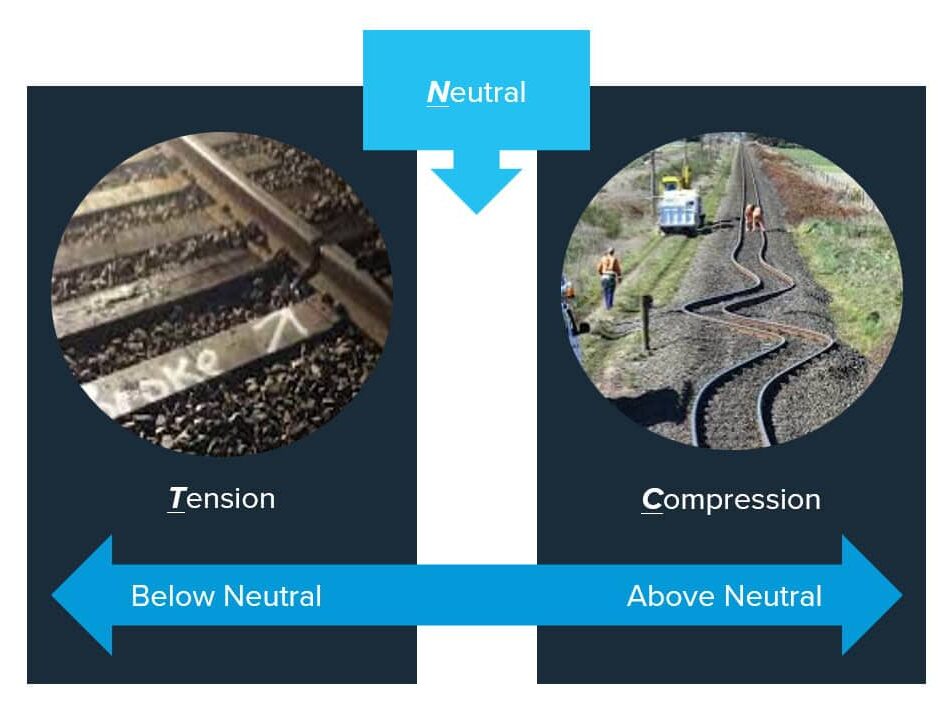
In a restrained system: temperatures above RNT generate compressive forces, and temperatures below RNT generate tensile forces.
These forces, known as Rail Axial Thermal Forces, can be extreme in magnitude. Because of rail stiffness and the long, uninterrupted lengths of CWR, even a few degrees of temperature change can generate tons of longitudinal force within a single rail segment.
Critically, these forces do not dissipate over time and remain stored in the rail until released through cutting, destressing, or welding.
Why Rail Neutral Temperature Matters
RNT is the temperature at which the rail is neither in tension nor in compression and in a stress-neutral state within the track structure.
Failing to establish or preserve the desired RNT compromises the integrity of CWR. Over time, this leads to:
- Increased risk of buckling in hot conditions
- Increased risk of fractures or breaks in cold conditions
- Long-term operational hazards and escalating maintenance costs
RNT isn’t just a one-time consideration; it’s a condition that must be actively managed throughout the life of the track.
Coming Next: In Part 2, we’ll examine how thermal forces are restored through destressing, the common mistakes that lead to buckles and breaks, and why accurate force control is essential to preserving Rail Neutral Temperature.
This article was originally published by Holland.