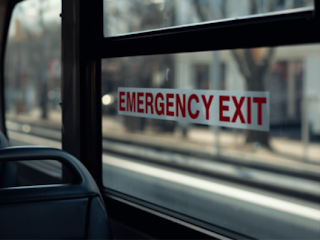
Human Behaviour Remains the Critical Variable in Rail Emergencies
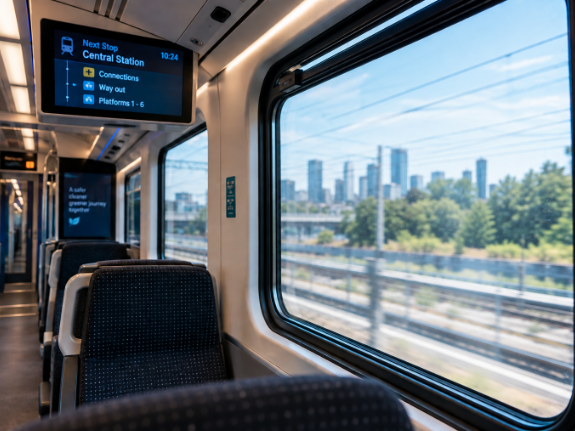
Rail transport systems continue evolving toward increasingly connected and automated operational environments. Modern passenger trains now incorporate integrated communications systems, digital passenger information platforms, predictive diagnostics and electronically controlled infrastructure designed to improve operational efficiency and network visibility. Yet despite these technological advances, emergency evacuation still depends heavily on human behaviour under stress conditions.

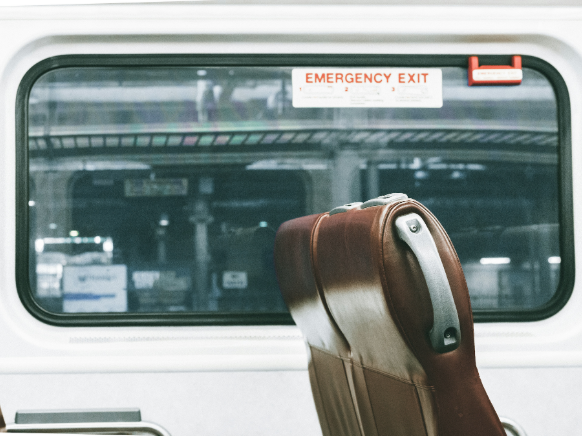
Emergency environments rarely unfold in predictable ways. Smoke propagation, panic, reduced visibility, confined spaces and passenger confusion can rapidly complicate evacuation procedures inside rail environments. During these conditions, passengers may struggle to identify escape routes, understand instructions or operate unfamiliar emergency systems quickly enough to evacuate safely.
Although UNECE Regulation No. 107 Rev.10 applies specifically to buses and coaches, its underlying resilience philosophy offers valuable lessons for rail transport. The regulation increasingly emphasises emergency usability under degraded conditions by reinforcing visibility, accessibility and operational simplicity within emergency egress systems.
This reflects an increasingly important engineering reality across public transport sectors: emergency systems must remain usable not only under ideal operating conditions, but during moments involving panic, confusion and infrastructure disruption. Human factors engineering therefore becomes a central component of transport resilience.
This broader philosophy also aligns with principles reflected in ISO 26262-1:2018, which emphasises maintaining safe outcomes during abnormal operating conditions and system failures. While developed for road vehicles, the underlying engineering logic increasingly applies to digitally integrated rail environments where passengers may need to make rapid decisions during emergencies involving smoke, electrical faults or systems instability.
For rail operators and manufacturers, this creates important design considerations. Emergency systems that are overly complex, electronically dependent or difficult to interpret under stress may increase evacuation delays during critical situations.
Mechanical emergency egress systems such as Safe-T-Punch™ support resilience-focused evacuation design because they operate through immediate physical interaction rather than layered software or electronic processes. Their simplicity helps preserve operational clarity during emergencies, reducing the cognitive burden placed on passengers already experiencing stress and disorientation.
As rail systems become increasingly sophisticated, passenger survivability still depends heavily on designing emergency systems around predictable human limitations during crisis conditions.
This article was originally published by Safe-T-Punch.