Rail vehicle certification is a complex, standardized process that ensures safety and quality. At Stadler, one focus is the rigorous testing of dynamic vehicle performance characteristics as well as ride comfort tests, among further areas. Capacitive accelerometers from the ASC OS series form the metrological basis for international homologation.

Strict Certification Tests for Rail Vehicles
Stadler, headquartered in Bussnang, Switzerland, is a leading international manufacturer of rolling stock. Its product range extends from trams and regional trains to double-decker, long-distance and high-speed trains. As an international corporation, Stadler runs engineering centers, production and component plants and more than 95 service locations across 25 countries.
New vehicle models or modifications involving significant changes must undergo certification testing before being permitted for use in regular passenger service. Key criteria for quantifying the running behavior of trains under realistic operating and infrastructure conditions are specified in the DIN EN 14363 standard. Not only do these tests serve to demonstrate operational safety, but also to confirm the level of passenger comfort (DIN EN 12299) as required by the respective customer. Type approval – the official procedure confirming that a new product meets the required technical and environmental standards – is supported at Stadler by an independent, in-house testing body and carried out by a specialized type approval management team.
To that end, certification processes are strictly regulated. They are based on international and European standards as well as country-specific regulations issued by the respective railway authorities.
Gian Spescha, Head of Measurement and Deputy Head of the Testing Laboratory at Stadler, said:As a testing laboratory, we must comply with countless formal criteria and undergo rigorous audits on a regular basis.
Testing is often conducted under extreme conditions on-site, as track gauges, overhead lines, environmental conditions and a host of other factors can vary from country to country.
Gian Spescha, Head of Measurement and Deputy Head of the Testing Laboratory at Stadler, said:We run tests on pristine high-speed tracks as well as on winding, worn-out routes – to simulate real-world operating conditions.
Inertial Sensors for Extreme Conditions: Low-Noise, Stable, Robust
Gian Spescha, Head of Measurement and Deputy Head of the Testing Laboratory at Stadler, said:To ensure reliable results, we need highly precise, robust and stable sensors. ASC’s accelerometers offer outstanding performance and data quality.
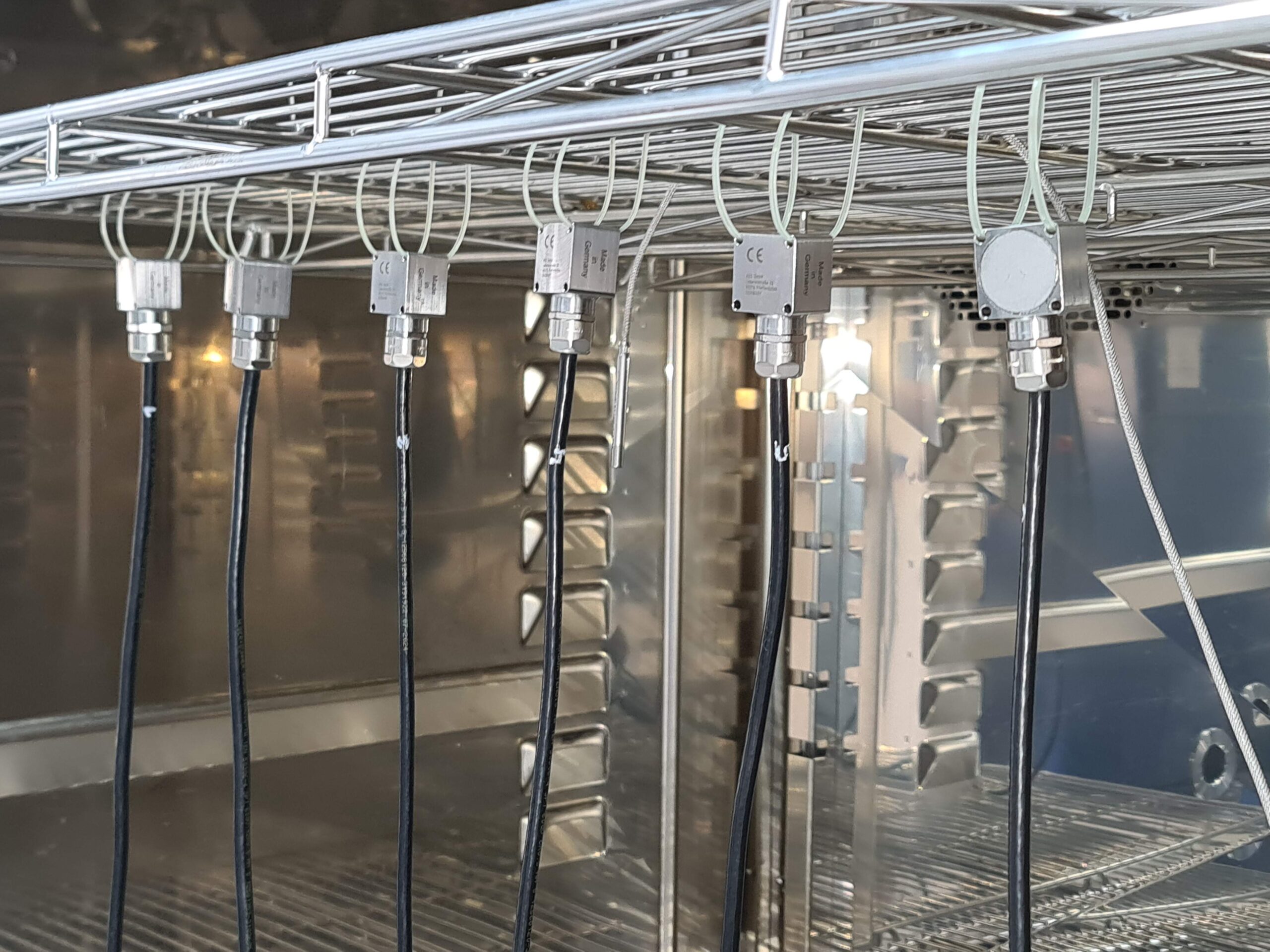
They are based on proven MEMS technology using the capacitive operating principle. The integrated circuitry provides differential analog voltage output (±4 V signal range) and supports flexible power supply ranging from 6 to 40 VDC.
Gian Spescha, Head of Measurement and Deputy Head of the Testing Laboratory at Stadler, said:Their practical, flexible installation options are also a great help. While size and weight are often not decisive factors in the rail sector, it’s important that we can mount the sensor easily and securely.
Further, the ASC OS series is characterized by high long-term stability in the measurement signal and its extreme robustness.
Philipp Feurstein, Measurement Engineer in the Vehicle Dynamics department at Stadler, said:Both are crucial.
In particular, very strong forces act on the primary spring stage at the wheel-rail contact, resulting in acceleration forces of well over 100 g in the Z-direction of the vehicle coordinate system.

Philipp Feurstein, Measurement Engineer in the Vehicle Dynamics department at Stadler, said:These impacts must not damage the sensors used, nor must they affect the measurement results.
Safety-Critical Driving Dynamics Tests on the Bogie
The heart of every rail vehicle is the bogie. Forming the link between vehicle body and track, it must withstand enormous physical forces. Intensive dynamic safety tests evaluate how the bogie and the entire train behave at various speeds, on diverse track profiles, under varying track conditions and in curves of various radii. The data gained provides important insights into the vehicle’s behaviors in relation to operating conditions, infrastructure characteristics and the critical wheel-rail interaction.
A key objective of dynamic performance testing is to verify running stability and derailment safety. To analyze dynamic behavior and implement appropriate measures for vibration damping and component optimization, the Stadler measurement team uses instrumented wheel sets and bogies. Uniaxial accelerometers ASC OS-115LN-PG with measurement ranges of 5 and 50 g (available up to 400 g) are mounted on the bogie frame, the wheel set bearings and the vehicle body to measure vertical and lateral accelerations.

Philipp Feurstein, Measurement Engineer in the Vehicle Dynamics department at Stadler, said:All stages of the bogie are safety-critical. Of particular relevance are the conditions at the primary spring stage on the wheel set as well as the secondary spring stage on the bogie frame. That’s where the strongest acceleration forces occur. Which is why we leverage diverse sensor technology in those areas.
ASC OS sensors feature robust, reliable stainless-steel housing of protection class IP68. Therefore, they are particularly well-suited for harsh environmental conditions where oil, dust and stone chips can affect the reliability of the measurement technology used.
Sensors of the ASC OS type come equipped with an integrated cable of configurable length and connection options, as plug connections can come loose due to the severe shocks on the bogie. User-friendly, pre-drilled holes for metric screws facilitate installation. As threaded holes can affect the structural integrity of components, mounting plates are used, which are supplied by ASC; these are simple yet effective accessories. The sensors are first screwed onto the mounting plates and then bonded to the measurement points. Upon completion of testing, the sensors can be unscrewed and repurposed, while the plates are being knocked off.

Low-Noise Sensors for Optimal Running Dynamics
Philipp Feurstein, Measurement Engineer in the Vehicle Dynamics department at Stadler, said:We are primarily interested in the lateral movement of the frame. This is essential for characterizing running dynamics.

As rail vehicles exhibit a natural sinusoidal motion of the wheel sets due to the conical wheel profiles. This motion consists of a lateral displacement of the wheel set and a coupled yaw motion around the vertical axis (Z-axis). For small deflections, this motion can be characterized as approximately sinusoidal. Since the wavelength remains largely constant, its frequency increases with rising travel speed. Once the critical running speed gets exceeded or if the undercarriage is insufficiently damped, that sinusoidal motion can become instable and transition into safety-critical swaying. Vibrations can build up, leading to severe lateral vehicle movements and increased flange forces, resulting in so-called hunting oscillation.
ASC’s LN (Low-Noise) accelerometers feature an excellent signal-to-noise ratio and a precise frequency response below 10 Hz – essential requirements for the demanding measurement of low frequencies and the resulting lateral accelerations of a few tenths of a m/s².

Ride Comfort Assessment for Customer Satisfaction
However, what good is a highly secure train if the journey becomes an ordeal for passengers? Passenger comfort is often a key selling point. It is, therefore, also thoroughly evaluated during test runs. This evaluation takes into account a range of factors that impact passengers’ subjective and objective well-being.
Gian Spescha, Head of Measurement and Deputy Head of the Testing Laboratory at Stadler, said:Ride comfort measurements do not play a role in the approval process itself. However, they are part of the contract with the customer.
Ride comfort is generally quantified according to European standard EN 12299. This defines so-called “comfort indices” for vertical and lateral movements. To determine these, highly sensitive accelerometers are placed inside the vehicle body, particularly above bogies and across the passenger compartment.

For this purpose, Stadler uses ASC OS-315LN-PG triaxial accelerometers (measuring range: 2 g). Measurements capture low-frequency vibrations (which can cause motion sickness) as well as high-frequency shocks caused, for example, by uneven rail joints or switches. The measurement data is analyzed using specialized software to provide an objective assessment of ride smoothness. The rail vehicle is only accepted by the customer if the agreed thresholds for seating, standing and reclining comfort are met across all areas.
Accurate Measurement Results – Through ASC’s Calibration Service
ASC inertial sensors offer outstanding long-term stability of key parameters. This is verified through regular calibration to ensure consistently reliable and accurate measurement results. ASC, therefore, offers both DAkkS-compliant and factory calibrations for accelerometers of all makes, as well as further sensor types. ASC’s calibration laboratory, equipped with state-of-the-art technology, is accredited by DAkkS (German Accreditation Body) in accordance with DIN EN ISO/IEC 17025:2018 for the measurement of acceleration, covering both sinusoidal and shock calibration. DAkkS-accredited calibration certificates demonstrate traceability to national standards, as required by DIN EN ISO 9000 and DIN EN ISO/IEC 17025 standards.

Stadler’s measuring experts regularly utilize the ASC calibration service.
Gian Spescha, Head of Measurement and Deputy Head of the Testing Laboratory at Stadler, said:That’s also due to our role as an independent testing laboratory.
Because the standardized process mandates regular inspections and fixed calibration cycles for all sensor products used in the certification process.
Gian Spescha, Head of Measurement and Deputy Head of the Testing Laboratory at Stadler, said:ASC really provides us with an ‘all-inclusive, worry-free package’ here. The team is flexible in responding to our needs. Particularly in the independent testing environment, this helps us a great deal in demonstrating the traceability of the measurement signals.
Innovative Collaboration
Philipp Feurstein, Measurement Engineer in the Vehicle Dynamics department at Stadler, said:We appreciate the professional, straightforward collaboration with the ASC Sensors team. As a measurement engineer, it’s great to work with partners who clearly share extensive technical expertise and a passion for joint innovation.
Gian Spescha, Head of Measurement and Deputy Head of the Testing Laboratory at Stadler, said:At ASC, the lines of communication are short. You get answers right away and solutions quickly. Since Stadler’s testing facility operates a large number of sensors virtually around the clock, a trusting, straightforward collaboration without tedious bureaucracy is of major advantage.
The railway certification process at Stadler is a multifaceted one in which absolute safety and optimal ride comfort go hand in hand. Using state-of-the-art measurement technology on the bogies and in the passenger compartment, Stadler ensures that its rail vehicles not only meet the strict regulatory requirements but also exceed the high expectations of customers and passengers for a safe and relaxing ride.
This article was originally published by ASC Sensors.