As Balgray Station opened yesterday, 27 September 2026, its new footbridge shows what early involvement from a specialist lighting supplier can achieve.
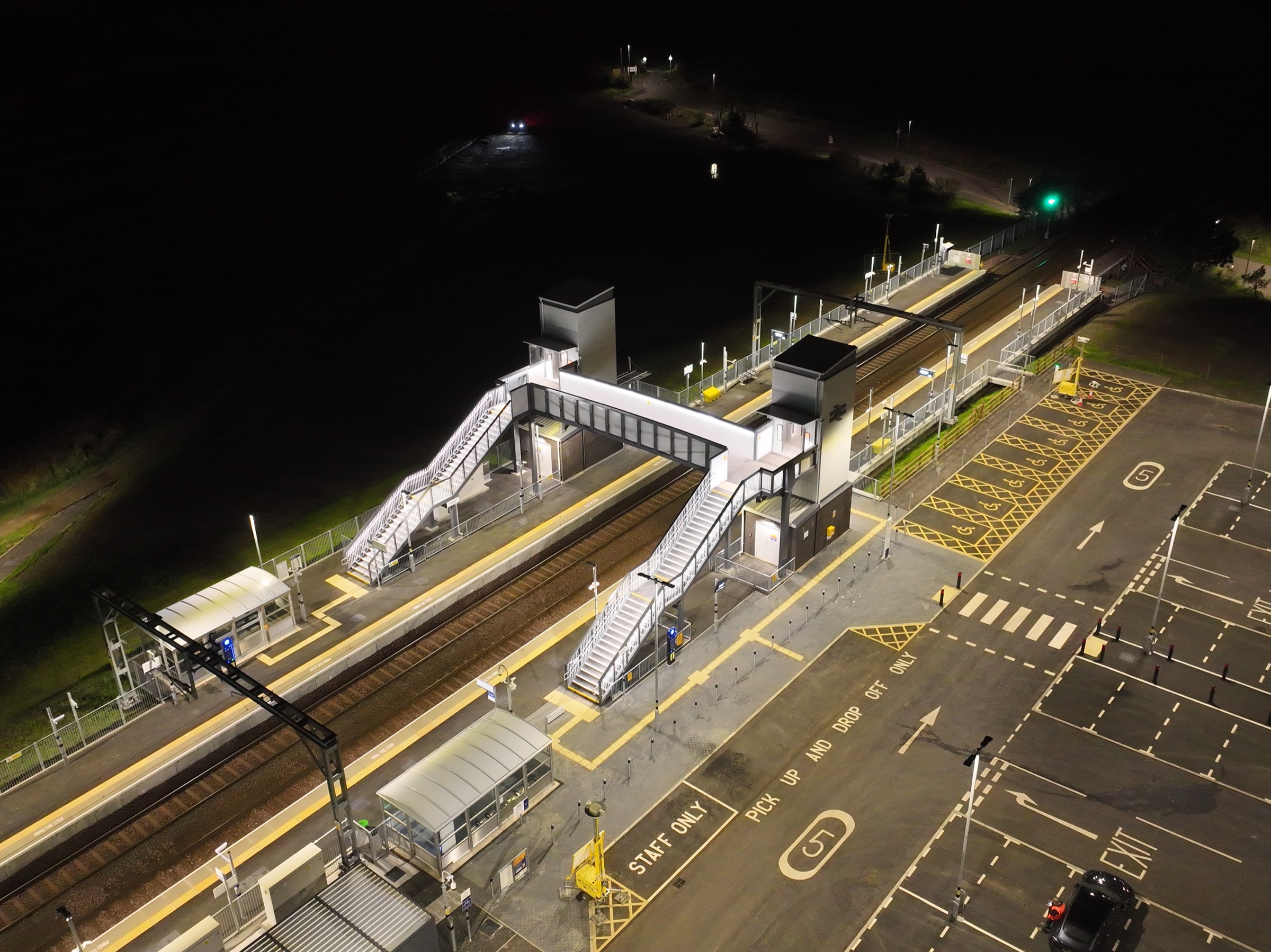
Balgray is a new station on the Neilston branch of the Cathcart Circle Lines, to the south of Barrhead in East Renfrewshire. Built to serve the existing Barrhead community as well as new housing developments in the area, it will provide a direct rail connection into central Glasgow as well as offering visitors direct access to the Dams to Darnley Country Park and Balgray Reservoir by rail.
The £18.3m new-build project, led by Network Rail Scotland, was planned, designed and built by Transport Scotland, ScotRail and Story Contracting, supported by a number of sub-contractors and consulting engineers.
Bringing in a Specialist
Among the infrastructure delivered as part of the project is a new Access for All (AfA) footbridge connecting the platforms. i-vision Lighting Solutions supplied and installed the lighting system for that footbridge, contracted through Kelly Rail UK.
Geoff Jones, i-vision’s Managing Director, was first approached about the project back in 2024 by consulting engineers SVM Glasgow off the back of the company’s track record. i-vision has worked on 14 lighting projects across the Scottish rail network including the 102-metre-long Mountfleurie Bridge in Levenmouth, Fife, and the Dumfries Station footbridge.
The lighting package was subsequently put out to tender, with i-vision ultimately contracted through Kelly Rail UK to deliver the footbridge lighting. The solution built on i-vision’s experience of linear lighting systems for rail footbridges, where controlled, low-glare illumination can be integrated discreetly into the structure.
From here the process followed i-vision’s usual pattern: design drawings formed the basis of a lighting plot, checked against the practical realities of the site, before the company designed the fittings, power supplies and emergency provision the bridge would need.
The one significant departure from i-vision’s usual approach came from emergency lighting. Normally, the company includes an integrated emergency lighting system with battery-backed circuits as part of its design. This is a dedicated control box that holds a number of circuits, each with its own battery back-up, designed to keep the lights running for several hours if the mains supply fails.
However, Balgray Station was designed with its own emergency back-up system, which could provide power to all equipment across the site in the case of power loss. For i-vision, this meant designing the footbridge lighting to work within a wider, centralised emergency power arrangement instead.
i-vision’s Lighting Solution
Following the design work, i-vision went on to manufacture and supply the solution. This centred on its Elektra 1712 G2 linear LED system, mounted at a 35-degree angle to direct light where it was needed while sitting neatly against the bridge structure.
The finished package included 37 Elektra 1712 G2 luminaires, in a mix of standard and project-specific lengths, an aluminium carrier and angle-mount system, IP67 connections, and two stainless-steel IP66 power and control enclosures supplying the 48V lighting circuits.
i-vision also carried out the specialist installation, which was completed this spring – six months ahead of the station opening to the public. This included mechanical installation of the lighting and mounting system, low-voltage connections, commissioning and recording the final light levels.
Benefits of Early Engagement
The installation went smoothly largely because of how early i-vision’s involvement began. That first approach from SVM Glasgow gave i-vision the chance to work through the practical details of the lighting before the final design of the footbridge was locked down.
For Jones, this is where early specialist involvement delivers its biggest benefit: resolving mounting, cabling, power, access and maintenance requirements on the drawing board rather than dealing with them as site problems.
Geoff Jones, Managing Director at i-vision, said:Getting involved early meant we could provide input into things like where the luminaires should sit, how they would be mounted, how cables would be routed, what power supplies were needed, and how the finished system would eventually be installed and maintained. By the time we got to site, we knew exactly what we were installing and how it fitted with the bridge. That’s far better than trying to engineer the lighting around a finished structure at the end of the job.
This is the real value of early engagement with a lighting designer – fewer unknowns once installation begins and fewer design issues to address – something all project managers want to avoid, as changes tend to be harder and more expensive to complete once a structure’s been built.
For i-vision, Balgray provides a useful model for future rail projects: bringing the lighting specialist into the conversation while the structure is still being developed, rather than treating lighting as a fit-out exercise once the major design decisions have already been made.