Noise deadlines are landing on operators’ desks across Europe. Traila, the Swiss wheel-rail interface company, has built the only full-stack answer: sensing, intelligence, chemistry and application, delivered as one service.
Here are the questions operators have been asking:
Q: Why has rail noise become a compliance problem, not just a complaints problem?
Because regulators and courts have started putting dates on it. In Ghent this year, the tram operator De Lijn was required through a conciliation hearing to propose measures to cut tram noise on the Bernard Spaelaan by 21 January 2026. The cause was not a crash or a safety scandal. It was curve squeal, the high-pitched noise a wheel makes as it rubs against the rail in a tight bend. On that one avenue, almost 700 rail vehicles pass on weekdays, and residents have recorded peaks of up to 100 decibels. London’s own Assembly has documented residents along the Night Tube lines reporting constant headaches, tinnitus and broken sleep. The direction across Europe is one way: the duty to measure noise is becoming a duty to act. Quiet is now a number operators are accountable for, with a date attached.
Q: Operators already buy lubricators, barriers and grinding programmes. What’s missing?
Ownership of the outcome. The wheel-rail interface is one physical system, but the industry sells it in pieces. One vendor supplies the friction modifier. Another supplies the dispenser. A third supplies the monitoring. A consultant reads the data. The operator glues it all together, and carries the risk when the squeal comes back. In Ghent, one trial fix – manganese strips set into the rails – cost over 100,000 euros for roughly 150m. That’s the price of not treating noise at the source. And the source is a moving target. Noise depends on many variables at once: wheel profile, vehicle type, speed, load, weather and the exact geometry of each curve. A fix that works on one curve can fail on the next. Beating that takes sensing, decision-making, chemistry and precise application working as one loop, not four purchase orders working as strangers.
Q: Traila is best known for its leading work on active steering for trams. How did this shift come about, and where does active steering stand?
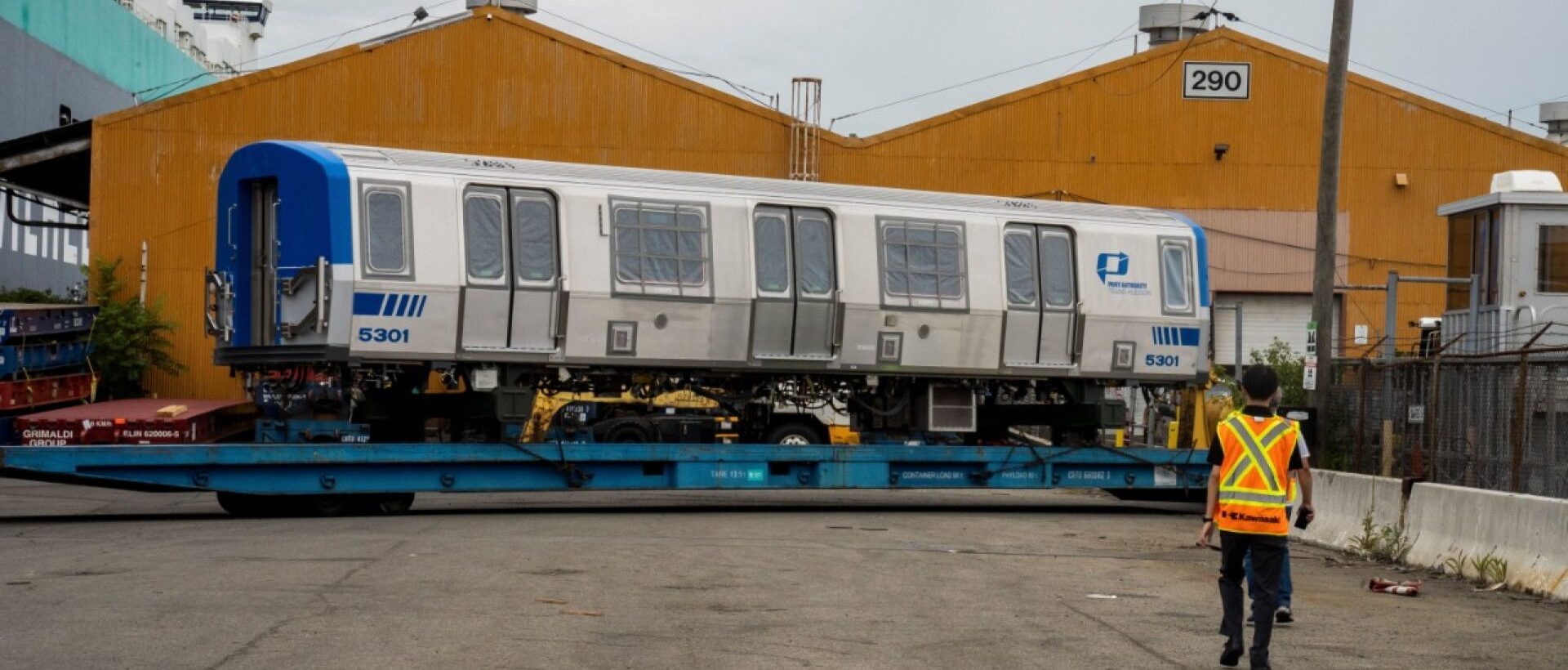
We never left the root cause; we added a second front. Traila’s foundation is active steering: instead of letting a wheelset fight the rail through a curve, you steer it. We have just finished a test campaign in Zurich with the TX4, a decommissioned T2000 tram we retrofitted with our active steering bogie and a full suite of measurement equipment. It showed that active steering works in two ways at once: by actuators steering the wheelset directly, and by steering torques applied to the independent wheels. That work now continues in our next-generation vehicle programme, where we are working with academic and industry partners on making it commercially viable.
The friction work grew out of that research. Igralub came to us because they wanted our curve-detection algorithms and our simulation and analysis toolchain. We soon realised what the combination could do: intelligent friction management treats the symptoms that generate noise today, on the fleets operators already run, while active steering solves the root cause in the vehicles of tomorrow. One company, working both ends of the same problem.
Q: What does the full stack actually look like?
It is Traila’s system, and we are accountable for it. We call the approach Interface Intelligence. Traila runs the intelligence layer: onboard monitoring that turns measurements from vehicles in service into a network-wide map of where noise and wear are actually created. The precision onboard monitoring hardware is available today, and the next generation of onboard monitoring and control is in development. One specialist partner builds with us. Igralub, the rail conditioning standard since 1992, brings the chemistry and the application systems: brake silencers, flange lubricants and top-of-rail conditioners that hold the running surface inside the narrow friction range where squeal stops. The result is what the market has not had before: Traila as the only provider offering the full stack as a single service. One point of contact. One system. One party accountable for the quiet.
Q: The lubrication is described as active, or smart. What does that mean on the track?
It means the conditioning responds to the network instead of running on a fixed schedule. Conventional top-of-rail and flange lubrication applies the same dose everywhere, at set intervals, and hopes for the best. We turn that around, in four steps: Measure the interface across the fleet. Map the hotspots that matter. Optimise the conditioning against exactly those spots. Monitor continuously, so the system keeps improving instead of drifting back. Because the monitoring never stops, the dose adapts to route, weather and traffic, curve by curve. The operator stops spraying everywhere and hoping, and starts conditioning where the evidence points. Every intervention is documented. When a regulator or a resident asks what was done, the answer is a log, not a shrug.
Q: What results has this produced, in numbers?
In conditioning programmes assessed for the Swiss Federal Office of Transport, the approach has cut curve squeal by up to 98% (documented at the BernMobil project), wear by up to 12%, and conditioning-agent use by up to 60%. Every hotspot is individual, and the effect holds only where it is monitored. That is exactly why the intelligence layer is not optional. None of this is a promise of identical results elsewhere.
Q: Where is the proof in service, and what does it cost an existing fleet to adopt?
It’s already running on networks you can ride today. Igralub has spent more than 30 years in this field and serves over 200 rail customers; its reference networks show what precise conditioning delivers. At the Mariazellerbahn in Austria, 38 hotspots are fully covered. Leipziger Verkehrsbetriebe runs onboard wheel-rail conditioning across its fleet. TPG in Geneva places its conditioning dose by GPS location across its network. Traila’s own systems are in live projects with operators in three countries. And adoption is not a rip-and-replace job. The conditioning hardware works with third-party systems already installed on the fleet, so the unit of upgrade is the controller, not the fleet. The chemistry is biodegradable across the range and carries the EU Ecolabel. Behind the system sit Traila’s credentials: IRIS certification, an ISO 9001 quality system, and seven active patent families across active steering, friction, monitoring and localisation.
Q: What should an operator facing a noise deadline do first?
Find out where your network actually hurts. Most operators have never seen a curve-by-curve map of their own noise and wear, and without one, every fix is a guess. That map is where we start, and it’s where the conversation with a regulator changes: from promises to evidence. The operators getting ahead of the noise issue will be the ones who stop buying fixes piecemeal. The wheel-rail interface has always made noise. Now there is one stack, and one provider, that can make it go quiet on command. Bring us your noisiest curve.
Traila is exhibiting with its partner Igralub at InnoTrans 2026, in the SwissRail Pavilion, Hall 2.2, Stand 250, where the full Interface Intelligence system will be shown for the first time. Book a briefing at the stand, or via Traila.ch.