The Digirail project introduces the first commercial ERTMS/ETCS Level 2 track section in Finland on the Tampere–Rauma/Pori line. The project is part of Finland’s national railway renewal programme, where signalling and train control are being modernised through a standardised, digital and interoperable architecture.\

Mipro supplies the SIL 4 EULYNX-based Object Controller System (OCS) for the Digirail project, together with technology partner Frauscher. The Object Controller serves as a link between the Centralised Safety System (CSS) and the trackside equipment with standardised interfaces. The OCS manages points, signals, level crossings, I/O and axle counters with added level of cybersecurity and remote diagnostics.
In the Digirail project, the Centralised Safety System (CSS) and the Object Controllers are delivered by separate companies under separate contracts but integrated as one functional system. Mipro delivers the OCS and CTC systems that will be implemented with an EULYNX interface to the CSS system. Mipro solution includes also an Automatic Train Operation (ATO-TS) for testing purposes.
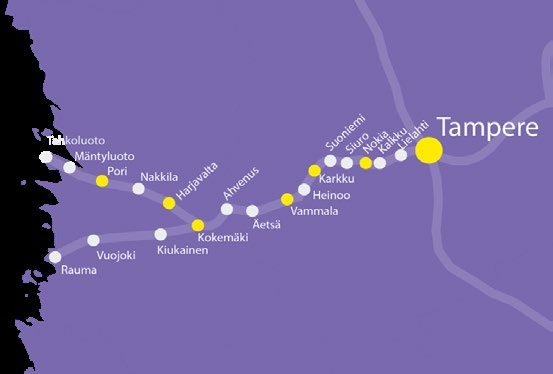
Digirail network architecture is built with standard EULYNX interfaces between the OCS, CSS and CTC to enable a multivendor implementation in the country. Through the Digirail programme Finland is acting as a European pioneer by utilising the highest safety-level technology and solutions that comply with the EULYNX standard.
Standardised EULYNX-Interfaces as the Basis for System Integration
The architecture is based on standardised interfaces between the Centralised Safety System, Object Controllers and field elements. The interface behaviour, communication parameters, national adaptations and protocol settings are defined through EULYNX specifications and project-specific Interface Control Documents (ICD).
This approach separates the field control layer from the central safety logic. It enables different suppliers to deliver independent subsystems that can be integrated through agreed, testable and documented interfaces. In practice, this requires systematic interface governance, consistent configuration management and close technical alignment between the customer, the CSS supplier and the Object Controller supplier.
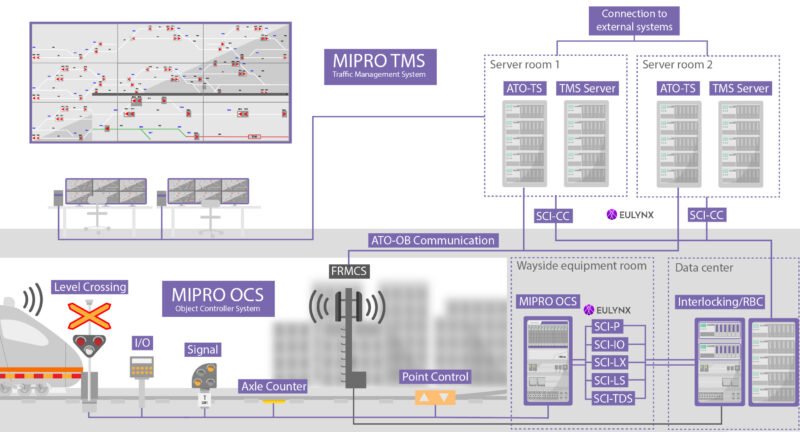
The implementation is based on EULYNX Baseline 4 Release 2. The project-specific ICDs define the communication parameters for RaSTA and SCI-protocols, as well as the relevant national adaptations. Critical communication interfaces are protected with TLS encryption. These interfaces form the technical foundation for interoperability, lifecycle maintainability and controlled system evolution.
For infrastructure managers, standardised interfaces support a more flexible renewal model. Individual system layers can be specified, tested and maintained with less dependency on proprietary wayside integration solutions.
Mipro Object Controller System between CSS and Field Elements
The Mipro Object Controller System forms the interface layer between the central safety logic and the physical field elements. It receives commands from the CSS, converts them into safe field-level control actions and returns status and indication data from the field back to the higher-level systems.
In the Digirail project, the Object Controller System supports multiple element types within the same EULYNX-based architecture. The scope includes points, light signals, train detection interfaces, level crossings and generic I/O. This makes the system a centralised multi-object controller platform rather than a collection of separate field-specific devices.
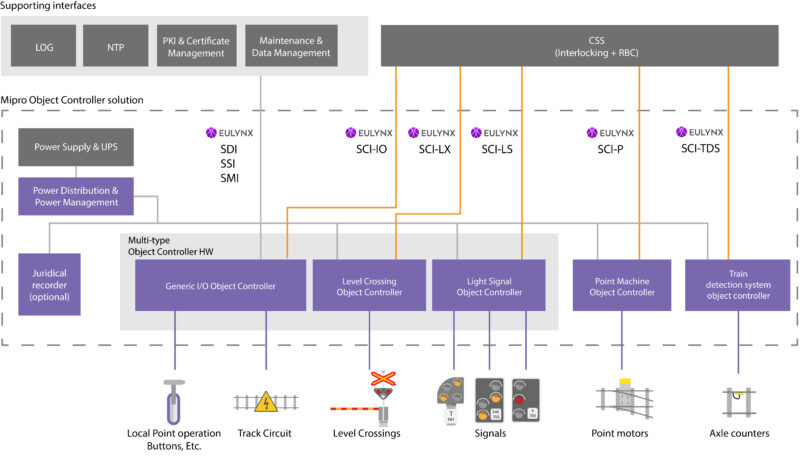
The topology illustrates the station-level Object Controller concept used in the project. Control functionality is concentrated into protected equipment room installations and connected to field elements through defined interface layers. This reduces the need for extensive distributed intelligence in field cabinets and supports controlled maintenance over the system lifecycle.
A centralised Object Controller architecture also simplifies cybersecurity management. Physical protection, software updates, access control, monitoring and configuration management can be handled more consistently from centralised locations. This is particularly relevant in railway environments with long operational lifecycles, strict safety requirements and demanding field conditions.
CTC and ATO-TS in the ETCS Operating Environment
Mipro’s CTC system forms the operational control layer for the Tampere–Rauma/Pori section. It provides the traffic control environment needed to supervise and manage railway operations in an ETCS Level 2 context.
The CTC is integrated into the wider Digirail architecture together with the CSS and field control environment. Its function is therefore not limited to visual traffic control. It supports operational supervision, phased testing, commissioning and future operating as ETCS is introduced more widely. Integration to CSS is made with EULYNX SCI-protocol enabling a standardised multi-vendor integration to other vendor’s CSS systems.
Mipro also provides ATO-TS functionality for testing and system validation. In the operating environment, ATO-TS enables automated operation concepts to be evaluated as part of the same technical system context as ETCS, traffic control and field element control.
Cybersecurity Integrated into the Signalling Architecture
Cybersecurity is part of the signalling system design in the Digirail project. Critical wayside communication is protected using TLS encryption, which requires secure endpoint management, Public Key Infrastructure and controlled certificate handling throughout the lifecycle of the system.
In a safety-critical railway environment, encrypted communication must be implemented without compromising operational continuity. This affects system architecture, interface implementation, maintenance procedures and testing. Certificate renewal, access control and secure communication endpoints must be managed in a way that supports continuous and predictable operation.
The multi-vendor structure of the project also makes cybersecurity a shared engineering responsibility. Requirements must be aligned across the customer organisation, CSS supplier, Object Controller supplier and other stakeholders involved in integration, testing and operation.
Laboratory-Based Integration and Interoperability Testing
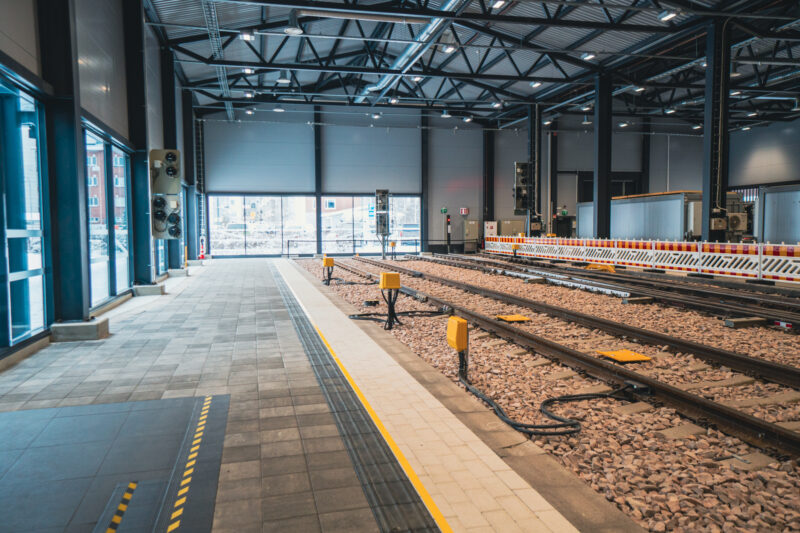
A shared laboratory environment is used to test the CSS, Object Controllers and real field elements together before deployment to the operational railway environment. This reduces integration risk and allows interface behaviour to be verified in a controlled setting.
The laboratory setup supports testing of timing characteristics, fail-safe functionality, end-to-end communication and compatibility between subsystems. This is especially important in a multi-vendor project where system components are developed and configured by different parties but must operate as one safety-critical system.
The project also includes third-party EULYNX testing as part of Generic Application FAT activities. Hardware-in-the-Loop testing is used to include real I/O behaviour in the validation process. This provides objective evidence that the implemented interfaces, communication protocols and interoperability mechanisms operate according to the expected EULYNX requirements.
Practical Implementation of Modular ETCS Architecture
The Digirail project shows how a modular ETCS architecture can be implemented in practice when the safety system, object controllers, traffic control and test automation capabilities are integrated through defined interfaces.
The technical scope covers several areas that are relevant for future railway renewals: EULYNX-based field control, CSS integration, secure communication, centralised Object Controller architecture, laboratory-based interoperability testing and lifecycle-oriented system management.
For railway infrastructure managers and system suppliers, the implementation provides a practical model for moving towards standardised, multi-vendor signalling architectures. The same principles support future ETCS deployments, brownfield migration and long-term maintainability in safety-critical railway environments.
This article was originally published by Mipro.