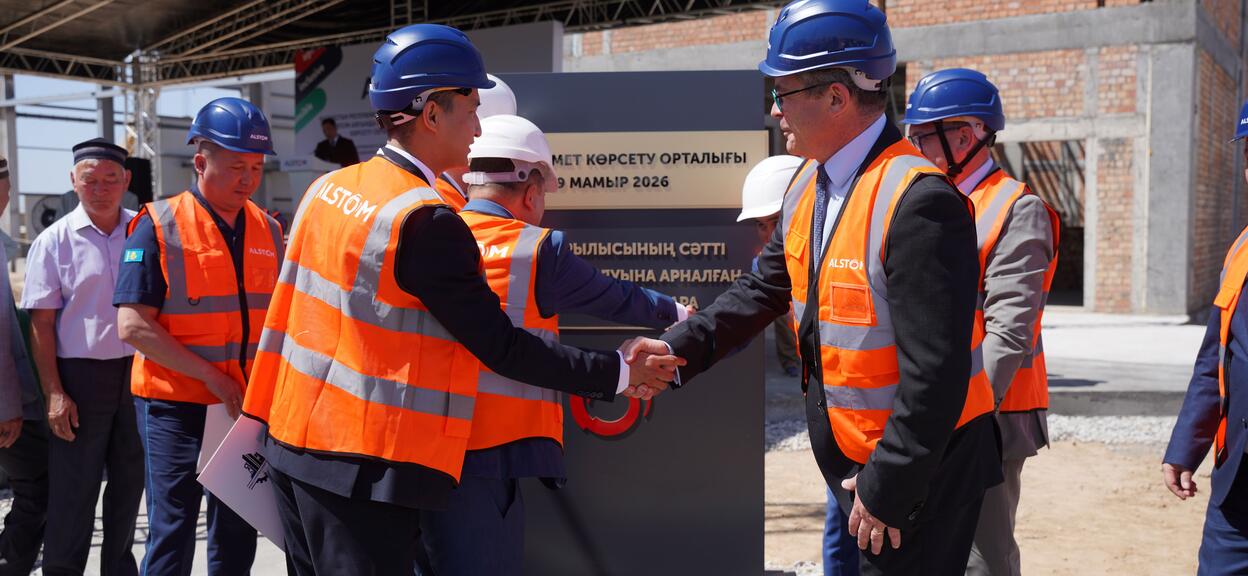
Alstom recently showcased construction progress of its new electric locomotive service depot in Arys during a site visit for both stakeholders and media representatives.
The new hub, which is located along the Middle Corridor, is one of four service facilities currently under development as part of an Investment Agreement signed in 2023 between Alstom and the Government of the Republic of Kazakhstan.
In 2025, Alstom inaugurated a depot in Shu whilst also launching construction of a similar facility in Astana. An existing service depot has also entered operation in Almaty.
This new facility in Arys will be used to service electric locomotives manufactured by Alstom for national railway operator JSC “NC Kazakhstan Temir Zholy”, and will be capable of servicing up to 120 locomotive sections per month (or 1440 per year).
Once operational, the project is expected to increase locomotive availability up to 97% in an effort to improve both the reliability and efficiency of rail operations domestically and along international routes.
The depot’s location is intended to strengthen its role as a service hub on the Middle Corridor, a key transport route connecting China and Europe via Kazakhstan.
The showcase event was attended by Yertai Altayev, Deputy Akim of Turkestan Region, Sylvain Guiaugue, the Ambassador Extraordinary and Plenipotentiary of France to Kazakhstan, as well as representatives of the Arys City Akimat, “KTZ – Freight Transportation” LLP, “KTZ – Passenger Locomotives” LLP and the Ministry of Industry and Construction of the Republic of Kazakhstan.
Attendees were presented with current construction process, key functional areas of the future depot, and visualisations of the completed facility, with Alstom representatives highlighting technologies set to be implemented, such as advanced solutions for diagnostics, maintenance and repair.
Jérôme Boyet, Managing Director of Alstom in Western and Central Asia, said:Developing service infrastructure for electric locomotive is key to Kazakhstan transport ambition and economy, because beyond the evident CO2 reduction, electrical locomotive operating cost is much lower than diesel.