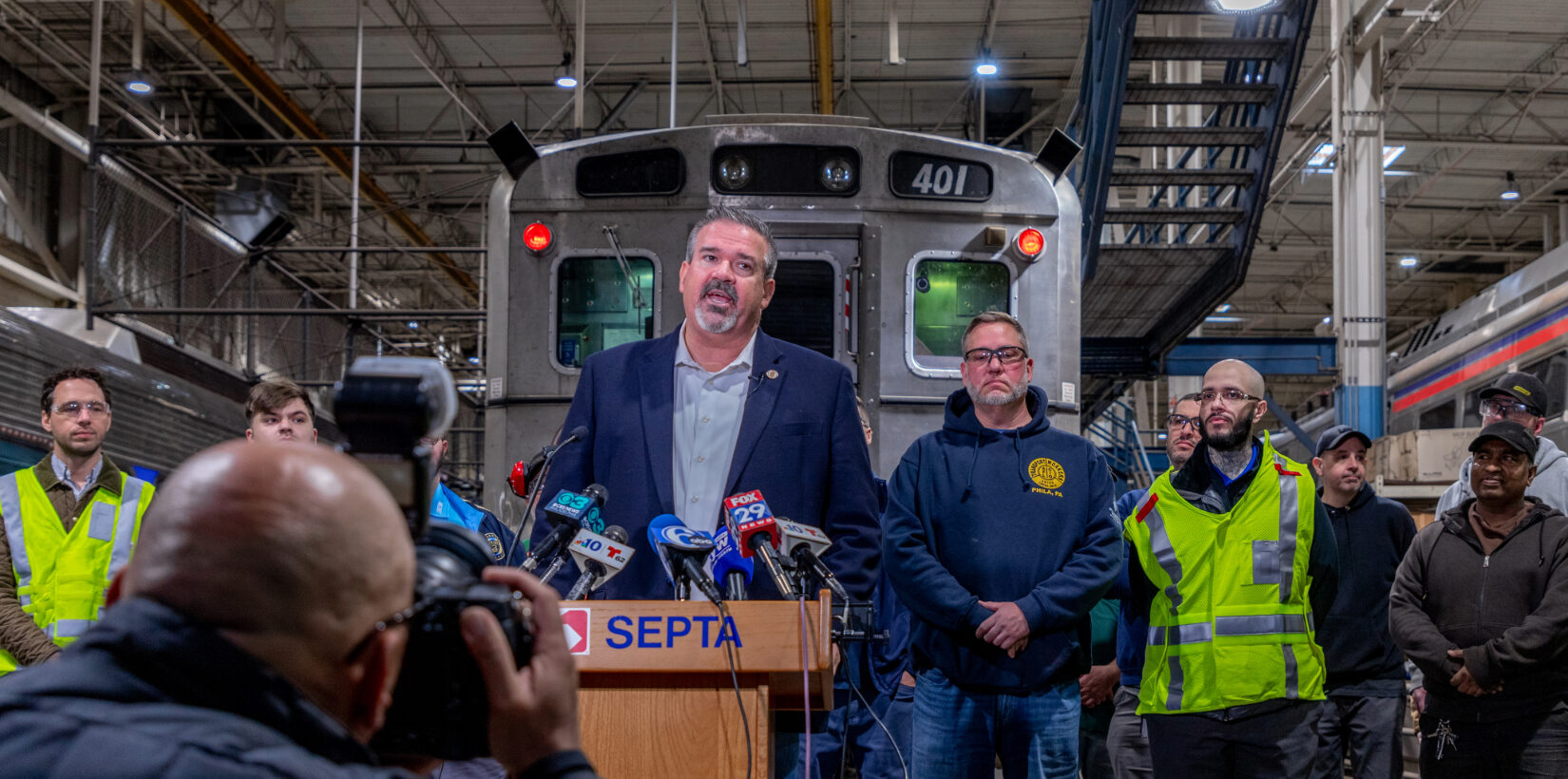
Earlier this week, California High-Speed Rail Authority CEO Ian Choudri provided a project update in interview with Executive Director Blake Zane on The Maddy Report.
The Maddy Report is a weekly public affairs show on KFSN ABC 30 that analyses how state and federal policies impact California through in-depth, balanced discussions aimed at fostering civic understanding. Ian Choudri’s episode can be viewed here.
During the interview, Choudri outlined the project’s history, its current status, and the challenges that continue to shape its future.
Choudri, who joined the Authority in 2024, stated that at the time, the project had reached a “moment where either we’re going to do it, or we are not going to be able to finish it,” motivating him to take on the CEO role to reshape delivery and restore public confidence.

Choudri talked through the early history of the project, noting that when voters approved Proposition 1A in 2008, expectations were set before critical details such as precise routes and sequencing were fully understood. That, combined with early federal funding requirements under the Obama Administration, created pressure to begin construction before land acquisition and utility relocation were complete. Choudri noted that the Authority should have instead “taken the time to buy the land on which we need to build the house,” rather than mobilising contractors while thousands of parcels remained tied up in disputes and litigation.
Despite those early missteps, Choudri emphasised that the project’s construction is now advancing in a disciplined and predictable way. The Central Valley segment, spanning 120 miles between Merced and Bakersfield, is on track to have guideway construction completed by the end of 2026, with track installation beginning shortly thereafter. Materials such as rail, catenary systems, poles, and power equipment are already being procured, and the Authority has completed a major logistics facility in Wasco to receive shipments via the national freight rail network.
Looking ahead, Choudri stated that the Authority’s next business plan, expected in early 2026, will outline a streamlined strategy to extend service north to Gilroy and south to Palmdale, with full connections to San Francisco and Los Angeles. If the project receives stable funding and the jurisdictional powers necessary to navigate permitting and right-of-way challenges, he believes key extensions to Merced, Gilroy, Palmdale, and Bakersfield could be completed by the late 2030s.
Choudri also addressed recent criticism, particularly following federal decisions to cancel 4 billion USD in grants, arguing that large US infrastructure undertakings have always faced delays and challenges. He urged the federal government to remain a partner, noting that high-speed rail is public infrastructure with long-term economic value.
California High-Speed Rail Authority CEO Ian Choudri said:Anytime an initiative in this country as big as this one has been undertaken in the past, the federal government has always partnered with local states and local governments. So it is sad to see that the federal government is where they are today. This is a public infrastructure project paid for by the taxpayer, and they want to see the results.
We have challenges, but they are no different from the challenges we had when we built the Big Dig in the northeast or when we built the interstate highway grid. I wish we were in the desert and there was nobody there, and we could have just done it like China. But we are not. And so we need to live in reality.
If we are funded and have all the jurisdictional powers to do what we want to do, we can connect Merced, Gilroy, and Palmdale by
2038. It is doable. It is a public infrastructure project, so let's not politicise it and use it as anything other than public infrastructure. I just want to find a way to tell the federal government that it is public infrastructure, not a game.
Choudri acknowledged that scepticism and criticism will persist until trains are running, but stressed that the project’s physical progress, including 57 miles of completed guideway, is “real, visible, and accelerating.”
Finally, Choudri underscored the transformative potential of high-speed rail for the region, citing global examples where rail connections between major cities and smaller communities spurred rapid economic growth. A future 45-minute trip between Fresno and San Jose, he argued, would reshape regional opportunities, support business expansion, and unlock new economic development in cities like Merced, Madera, Bakersfield, and Palmdale.
Choudri emphasised:This is not something we are inventing. This is how high-speed rail transformed Japan, Spain, Italy, the UK, Germany, and France.
Watch the full interview here.