Alstom has celebrated service entry of BVG’s very-first extra-long Urbanliner tram.
At 50 metres in length, the trams have now entered service on the M4, one of the busiest lines on Berlin’s tram network.
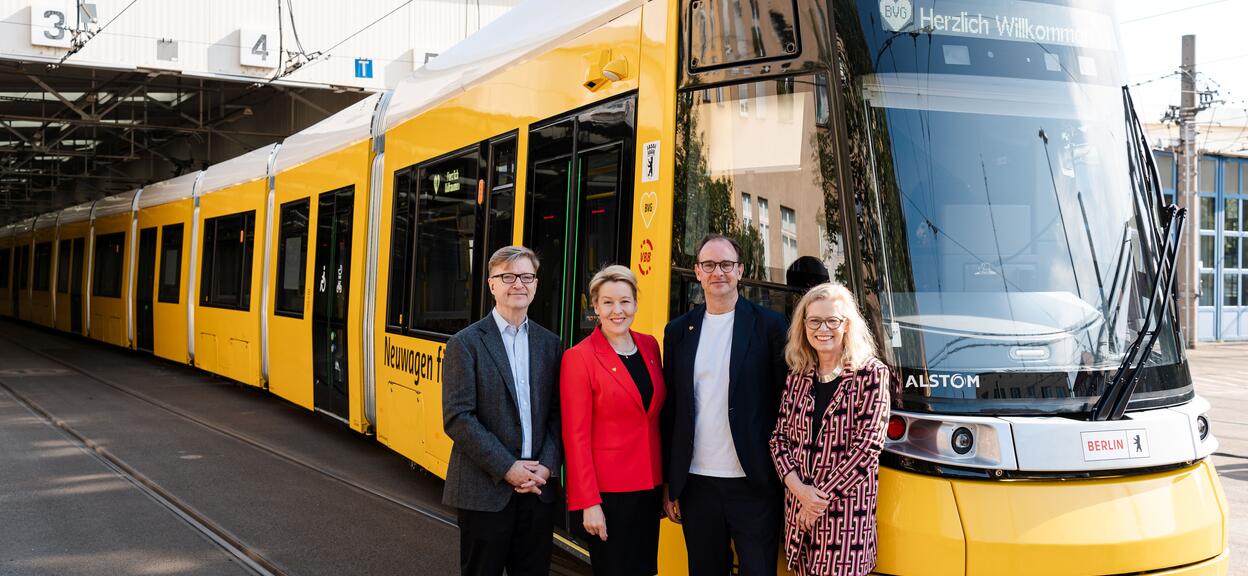
Passengers were invited to experience the new space for themselves during the official maiden journey, with attendees also including Senators Franziska Giffey and Ute Bonde.
Prior to the official handover for passenger service, minor adjustments to infrastructure within the Alexanderplatz area were required as part of the approval process and, following structural recalculations, two additional supports were installed in the underground tunnel to provide extra safety against a higher calculated load scenario.
BVG’s Chief Executive Officer Henrik Falk, said:As the BVG team, we acted swiftly and purposefully to overcome the final hurdles. All the conditions are now in place to bring a new dimension to Berlin’s public transport.
With these new vehicles, we are ensuring that, following the underground, the tram fleet is also well-equipped for the coming decades. What we are currently achieving is by no means a matter of course: rarely have so many forward-looking projects been launched simultaneously as they are today.
The Urbanliner is yet another visible sign that we are consistently investing in modern vehicles and high-performance infrastructure for Berlin.
Alstom has now begun delivering additional Urbanliner trams to BVG, with the fleet set to grow to around 15 vehicles before the end of this year and expected to double again by 2028. The remainder of the 65 Urbanliners currently on order are then expected to follow by 2030.
Approval for the trams was granted on a route-by-route basis, with the new trams currently approved for use on Berlin’s busiest tram route, the M4. In the future, they will be used on other routes.
Each of the new trams can accommodate over 300 passengers, and will replace GT6 trams currently operating on the M4 – which are coupled to form double trains and will gradually begin being taken out of service. The trams operate without exterior mirrors, instead opting for a camera system that aims to improve the driver’s rear view across all situations, eliminating blind spots. This is coupled with a new assistance system that warns of potential obstacles in the vehicle’s path.
Finally, in response to changing demand patterns, the Urbanliner is the first type of Berlin tram to operate without mobile ticket machines, adapting to passengers’ purchasing behaviour.