As urban centres expand and integrate with existing infrastructure, mitigating ground-borne vibration from railway operations presents a significant engineering challenge with direct impacts on nearby communities, writes Pliteq’s Engineering Lead for Rail and Ground-Borne Vibration, Mykola Tverdokhlib.
Residents living close to rail lines often experience disturbances ranging from perceptible vibrations within their homes to subtle rattling of objects, highlighting the necessity of effective mitigation strategies to enhance urban quality of life. Understanding and minimising these vibrations is crucial for the sustainable development of railway networks.
Proven Vibration Mitigation Expertise
Pliteq, with over 20 years of experience in the successful manufacturing of high-performance rubber track elastomers, stands at the forefront of noise and vibration control. Our GenieMat RAIL solutions are rigorously backed by extensive field data, laboratory testing and advanced track modelling, ensuring effective and reliable performance.
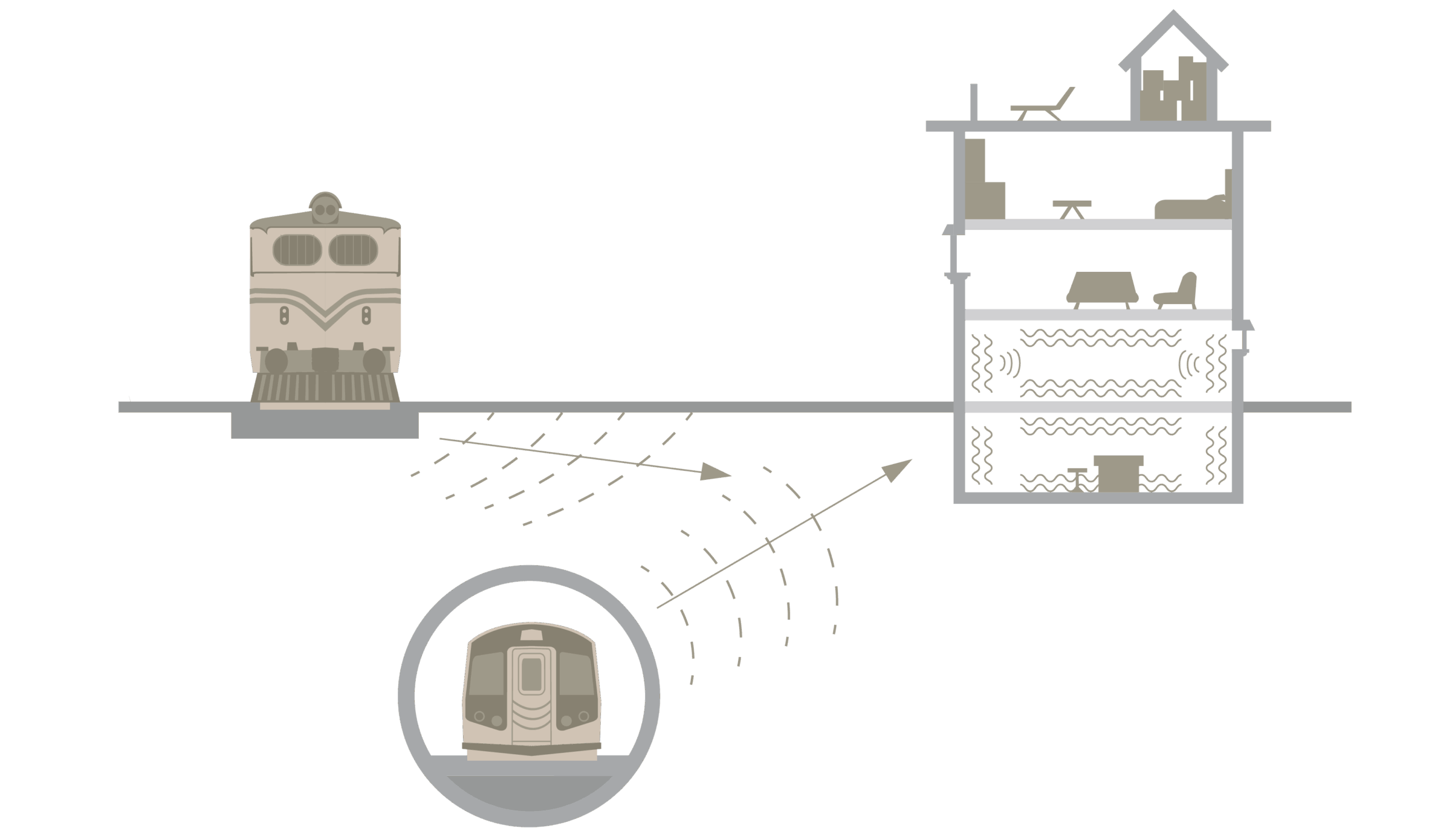
The genesis of ground-borne vibration lies primarily at the wheel-rail interface, where irregularities generate dynamic forces. These vibrations propagate from the rail, through the sleepers, ballast or slab, and ultimately into the subgrade. From there, they radiate through the ground, affecting nearby buildings and their occupants. For engineers, quantifying this impact is critical. Regulatory bodies, such as the US Federal Transit Administration (FTA), often provide guidelines, with vibration velocity levels of 0.14 mm/s RMS (or 72 VdB) at building foundations considered the threshold for concern.
It’s imperative to recognise that every component within the track structure significantly affects how vibration propagates and attenuates.
Engineered for Endurance
Effective vibration mitigation relies on decoupling the track structure from the surrounding ground. Elastomeric materials, particularly rubber, are ideal for this application due to their inherent damping properties and dynamic stiffness. Unlike static stiffness, dynamic stiffness describes a material’s resistance to deformation under dynamic, or oscillating, forces, such as those generated by the passing trains.
This property is therefore understandably crucial in rail applications, where materials are subjected to repeated cyclical loads that can cause fatigue and gradual loss of performance over time.
A carefully selected dynamic stiffness allows these materials to absorb and dissipate vibrational energy, preventing its detrimental transmission into the subgrade. Crucially, factors like frequency dependence and the long-term creep of the elastic modulus in these materials must be carefully considered during design to ensure sustained performance over the lifespan of the track. These characteristics are typically evaluated using industry standard testing, and advanced numerical and simulation tools are used to analyse the expected vibration reduction (insertion loss) and track deflection. These are factors Pliteq rigorously addresses in material selection and product development.
Pliteq’s Product Portfolio
Pliteq offers a range of proven solutions tailored to specific track designs and mitigation requirements, each optimised for its dynamic performance:
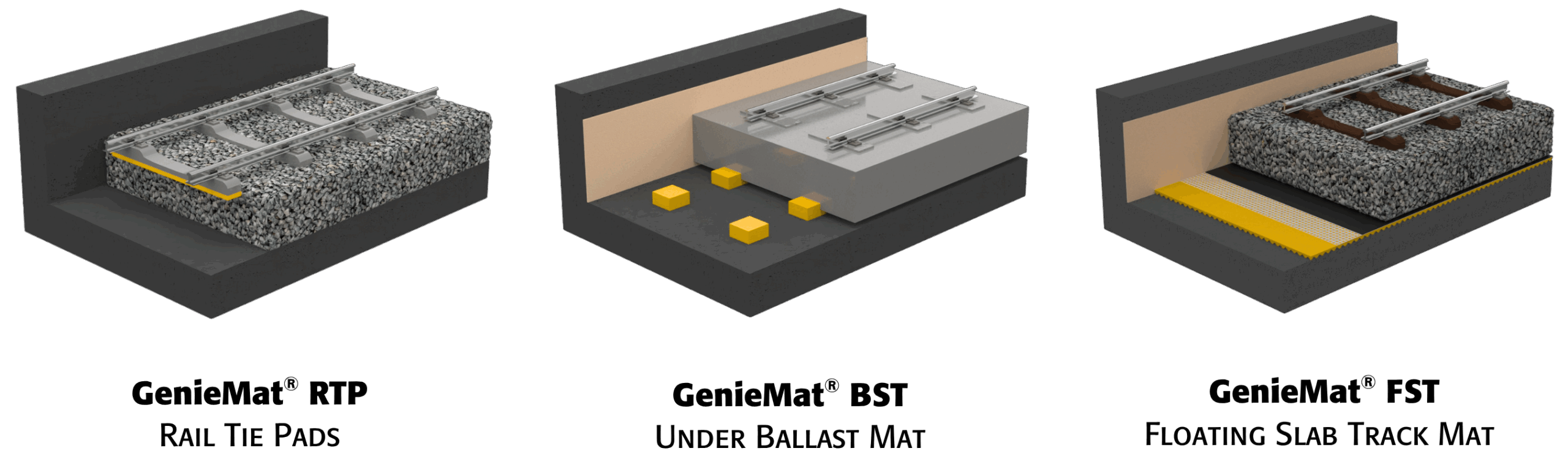
- GenieMat® RTP (under sleeper pads): Installed either glued to the sleeper or cast into concrete ties during manufacturing, these pads provide crucial damping directly between the sleeper and the ballast. Their optimised dynamic stiffness significantly reduces vibration propagation, typically achieving a 5-12 dB reduction. They are often the easiest and most cost-effective solution to implement in new or existing ballasted track.
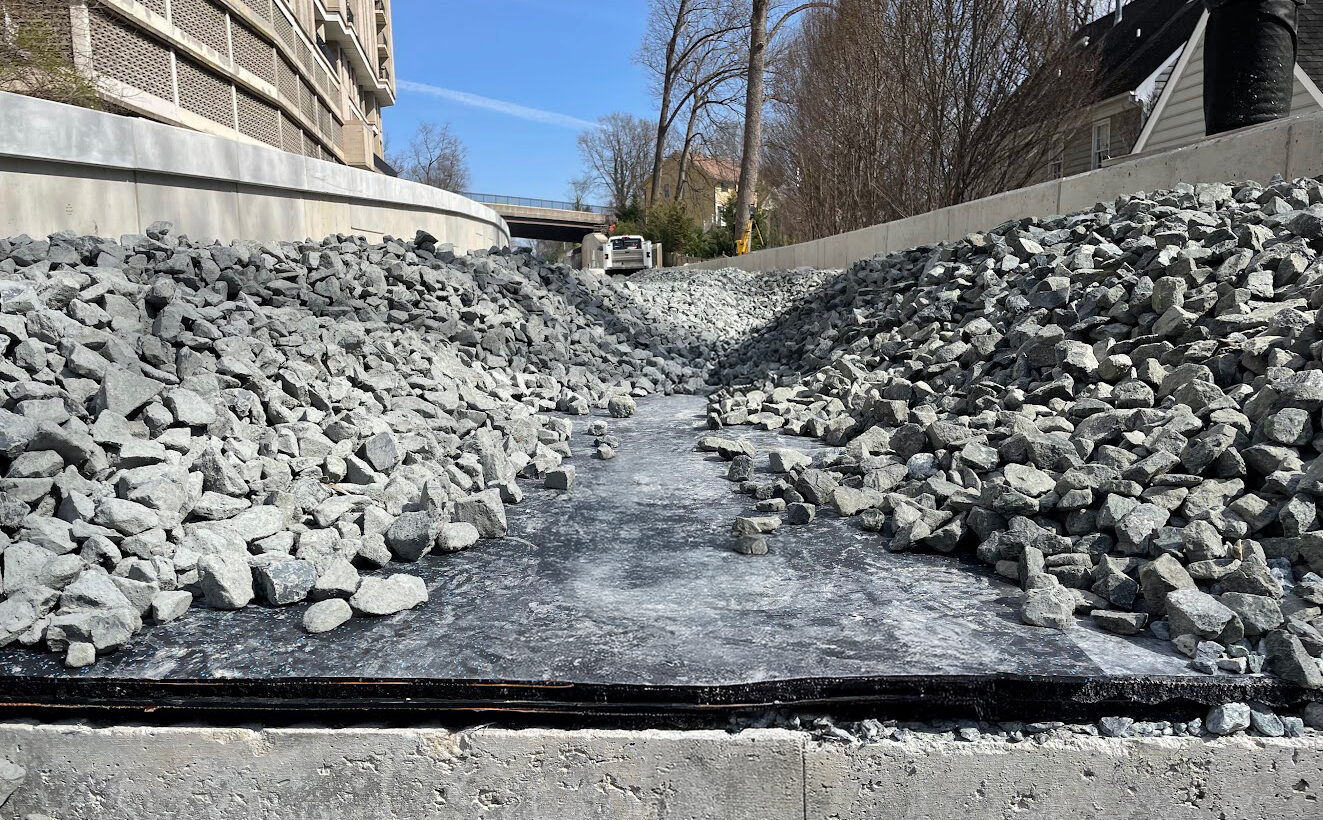
- GenieMat® BST (under ballast mats): For applications requiring more substantial vibration attenuation, GenieMat BST is rolled out on top of the subgrade, directly beneath the ballast layer. By providing a resilient layer with specific dynamic stiffness properties, it isolates the entire ballast section from the subgrade. This offers a 10-20 dB reduction in ground-borne vibration, providing a highly effective barrier.
- GenieMat® FST (floating slab track isolation): In the most demanding scenarios, particularly where very low natural frequencies (under 20 Hz) are required, GenieMat FST provides superior isolation for floating slab track systems. Its carefully engineered low dynamic stiffness is critical here, installed between the concrete slab and the subgrade, effectively decoupling the track structure and leading to 20+ dB of vibration reduction. This solution is typically employed in critical applications such as subway lines passing close to sensitive structures.
Partnering for Success
Choosing the right vibration mitigation solution depends on a thorough understanding of site-specific conditions, target attenuation levels and budgetary considerations. Pliteq’s extensive experience, deep technical expertise and comprehensive support can guide you through this selection process, ensuring optimal performance and compliance with stringent vibration limits for a quieter, more harmonious urban environment.
Contact Pliteq today to discuss your project-specific railway noise and vibration challenges. Our team of experts is ready to assist you in designing and implementing the ideal solution.