InfraView is bringing clearance monitoring and asset management off the track and into the office, with X2BIM.lira and X2BIM.objects both on show at InnoTrans 2026, writes Erik Kreer, Product Owner, X2BIM at infraView.
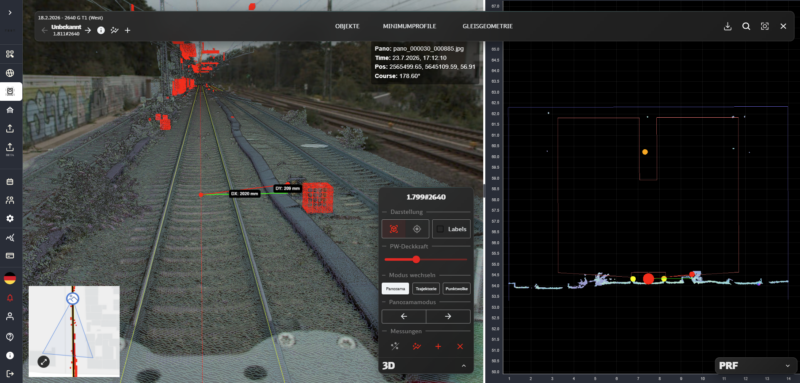
Clearance monitoring on the railway has long meant one thing: walking the track. Inspectors move through the network taking manual measurements, often with basic handheld tools. The process is effort-intensive and restricts operations while it’s underway, plus the data it produces can vary in quality. Adding to the problem, there’s often no clear visual picture of where objects and bottlenecks sit on the network, so even where data exists, it isn’t enough to spot and confirm an issue from a desk – someone still has to go and look in person.
Asset management is another big challenge for rail infrastructure managers. Rail networks run on databases of infrastructure objects, including signals and masts, but construction and maintenance work never stops, and there are rarely enough people to keep records current against it. That gap has been compounding for years, making it increasingly difficult to identify the true state of a network’s infrastructure.
Extending X2BIM’s Capabilities
At infraView, our answer has been to move that work off the track and into the office. Our X2BIM platform, jointly developed with DB Engineering & Consulting, is used for the multidimensional data acquisition of large infrastructures by combining data from multiple sources such as multicopter flights, laser scanning and mobile mapping (using sensors on a train) into point clouds and imagery, which then feed planning, operations and maintenance work.
Two new products have now been developed to extend the platform’s capabilities, helping to tackle the problems highlighted above.
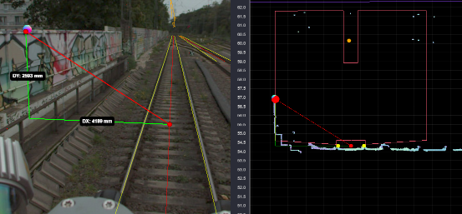
X2BIM.lira gives teams a visual model of the track to spot bottlenecks and potential collisions without walking the line, while X2BIM.objects uses AI to check infrastructure objects like signals and masts against existing asset databases, closing the asset-management gap.
X2BIM.lira
Supporting clearance monitoring, X2BIM.lira was developed in 2025 and has been in production use since the start of this year.
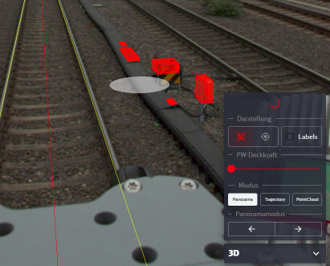
The value isn’t limited to catching mistakes a manual inspection might miss, though that happens too. The bigger shift is being able to run full measurement campaigns without sending anyone out to the track, with a reliable, repeatable measurement basis every time.
That matters most on routes carrying oversized loads. Moving abnormal or heavy goods often means checking clearance through narrow sections of track, and on a large network, doing that manually and frequently isn’t realistic with limited staff. The new .lira solution lets teams verify clearance without scheduling a fresh walk-through for every route check.
If and when an issue is flagged, findings are processed through a dedicated workflow and can be exported back to external clearance and bottleneck databases, in turn improving the quality of those databases over time, in the same way .objects does for asset records.
This enables users of the bottleneck database to utilise higher-quality data. This includes, for example, planning shipments of oversized cargo.
X2BIM.objects
Where .lira handles clearance, X2BIM.objects targets the asset side. It uses AI to detect infrastructure objects such as signals and masts from mobile mapping data, then compares them directly against the external asset database.
Reliability is built through cross-referencing: an object confirmed in both a point cloud and a panorama image carries a higher confidence score than one identified from a point cloud alone. Where the AI flags a mismatch, a user can step in directly. If an object appears in the mapping data but not the database, they can add it manually, and if it appears in both but the recorded details are wrong – a signal replaced during construction work, for example – they can correct the properties instead. That input feeds back into the external database, closing the gap between what’s recorded and what’s actually out there.
The databases .objects works from are incomplete or incorrect by definition, so there’s no fixed figure for how big that gap typically runs, as it depends on the state of each customer’s own records and the accuracy of the AI applied to them. Our aim is to correct that gap, improving the quality of the external database, campaign by campaign, until it reflects what’s actually out there on the network.
This solution is currently in development, with the aim to enter production in early 2027.
Human In The Loop
Both products come with a labelling tool, which is deliberate. AI models for object detection have to be trained per customer, because infrastructure looks different from network to network. A signal or a mast in Germany doesn’t look like its counterpart in England, so even a highly accurate model trained on one network won’t necessarily perform well on another.
Training a model for each customer means building a labelled dataset for it, which is heavy manual work in itself. infraView’s answer is to fold that work into how the tools are already being used, rather than treating it as a separate task.
When a domain expert runs a clearance analysis, they go through the track in detail, checking and correcting objects and issues as they go. Flag a mast that needs reclassifying, for example, and that correction doesn’t just update the one record: it’s shown in the labelling tool ahead of the next training cycle, so the model learns directly from the expert’s judgement rather than needing a separate labelling exercise built from scratch.
At infraView, we call this ‘human in the loop’. Rather than keeping the people using the tools separate from the AI behind them, every correction a domain expert makes becomes part of how the next version of the model gets built.
No More Juggling Tools
For engineers and asset managers, the biggest shift is doing this work in one place. Most people working on clearance or asset problems today don’t have a reality capture tool at all: comparing a new measurement against the database usually means switching between five or six separate programs just to see if the two match.
X2BIM puts the measurement, the database record and the visualisation in one screen, so a mismatch is obvious immediately instead of something you have to go hunting for.
It also means fewer trips to the track itself and the operational disruptions that come with it, since less of the verification work depends on someone being physically present to check.
infraView’s InnoTrans Lineup
infraView will be presenting the full X2BIM platform at InnoTrans 2026, alongside both .lira and .objects, at its stand in Hall A, Booth 110. We’re looking to meet people interested in reality capture platforms in the rail sector, particularly those exploring AI and object recognition use cases of their own.
Visitors can also expect to see other infraView products on the stand, including our DIANA.Fleet and Diana.infra solutions.
This article was originally published by infraView.