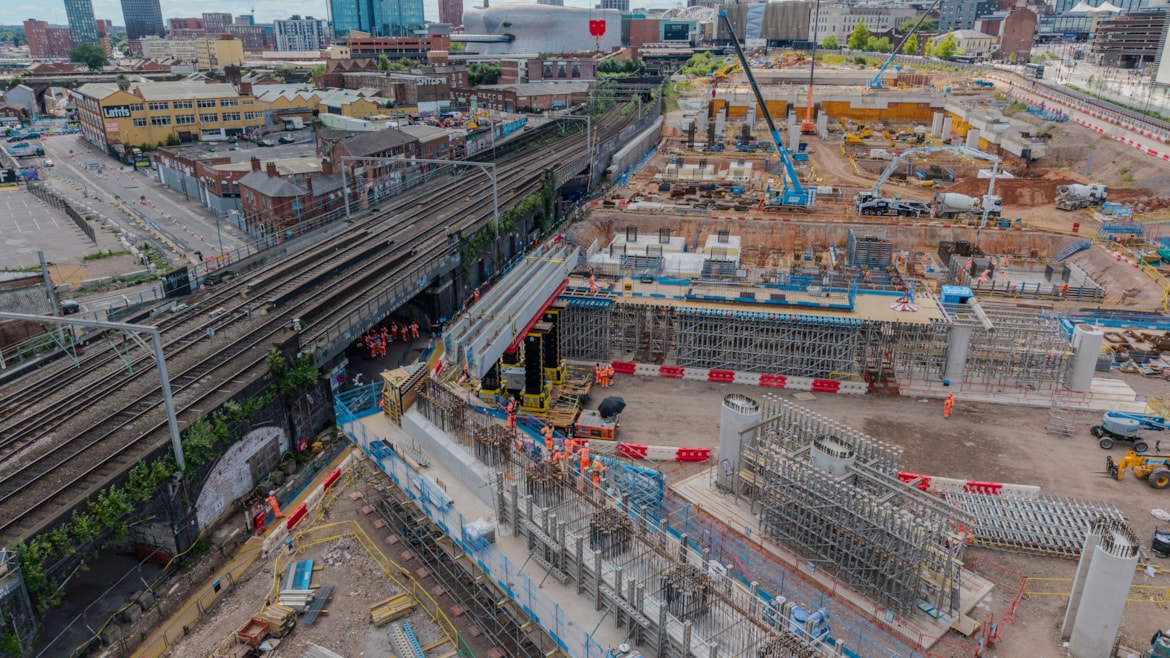
Construction of Birmingham’s new HS2 station, Curzon Street, is officially progressing with the first of over 556 concrete beams lifted into position.
The beams – up to 34 metres long and weighing 58 tonnes – will be used to support all seven platforms being built at Curzon Street station, with each one having been precast off-site before being moved into position as part of a major operation.
Once completed, the station will be covered by a large arched roof the size of London’s St Pancras International.
In March, HS2 Ltd announced that all 2,011 concrete piles that form a key part of the station’s foundations had officially been completed.
The station will stretch for roughly 450 metres between Moor Street and Millennium Point, and is expected to provide simple onward connections towards the city centre, Digbeth and Eastside.
A new tram stop will also be built under the station as part of the line currently under construction towards Digbeth and the site of the city’s new football stadium.
Construction of the new terminus is being led by HS2 construction partner Mace Dragados, which is working with subcontractors MPB to lift the concrete beams into place.
Work initially focused on the area in which the tram will pass under the station, allowing it to be handed over to Midlands Metro Alliance to begin laying track as early as possible.
HS2 Ltd’s Project Client for Curzon Street, Jonathan Berry, said:We’ve been making good progress with the construction of the station, but up to now, it’s mostly been beneath the ground – focused on the piling and foundations that will underpin the building.
That’s why it’s great to see the first beams in position as we begin to assemble the enormous deck that will support our seven high speed platforms. Once complete, Curzon Street will become a new gateway to Birmingham, offering easy access to the city centre and connections to onward destinations, via tram, bus and rail, improving journeys and supporting growth across the West Midlands.
All of Curzon Street’s seven platforms will be built in the on a viaduct-like structure and be supported by 188 concrete piers, forming a 13,370 square metre deck that will support part of the platforms and connect to the viaducts coming into the station from the east.
Each beam has been manufactured by Shay Murtagh Precast in a factory in Ireland before being delivered to the site by road, with transport planned to avoid traffic and arrive early in the morning.
Whilst the majority of beams will be lifted into position using large crawler cranes, up to 120 of the pieces are being lifted onto a specialised piece of equipment called a self-propelled modular transporter (SPMT) to be moved into their final position.
These cranes, which are supported by 96 wheels, allow the beams to be lifted from underneath and place them into position, avoiding the risk of using cranes next to the railway and allow services to keep running into Birmingham New Street during the work.
Over 2,000 piles ranging from 6 to 24 metres deep have been sunk into position thus far, with more than a thousand expected to be employed on the Curzon Street project at the peak of construction.