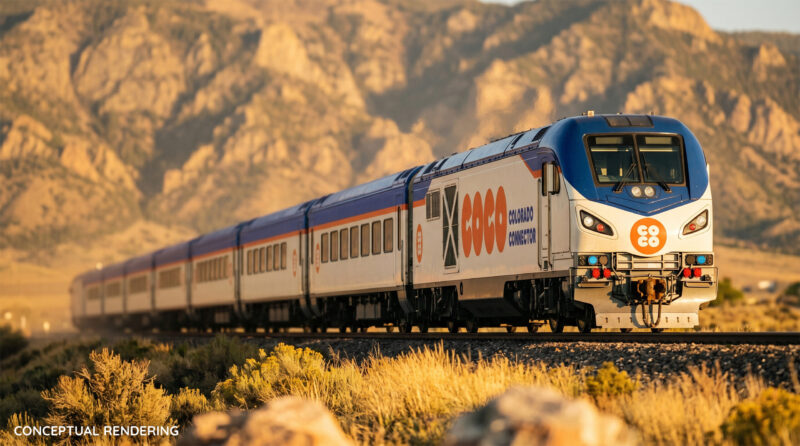
As Colorado voters prepare to decide on the future of the Colorado Connector, the project makes a case for incremental investment in passenger rail, using existing freight infrastructure and a phased approach to expand service.
On 3 November 2026, eligible voters within the Front Range Passenger Rail District will decide on Ballot Issue 7A, which would establish dedicated funding for the Colorado Connector (CoCo), a proposed passenger rail service linking communities between Fort Collins and Pueblo.
The proposal raises a question of how regions can expand passenger rail when new infrastructure is expensive, public funding is constrained, and previous transport commitments have left communities sceptical.
In a recent webinar hosted by the High Speed Rail Alliance, James Flattum, director of outreach for the Coloradans for CoCo campaign, outlined an approach built around existing railway lines, cooperation with freight operators and the gradual expansion of service. His argument is that Colorado does not need to begin with high-speed rail or wait for an entirely new railway to be constructed. Instead, it can start with conventional intercity trains and build towards a more enhanced network.
The proposal thus addresses a persistent challenge in North American passenger rail, which sets ambitious long-term plans against the funding, infrastructure and agreements required to deliver a service.
Building on Colorado’s Existing Railway
The Colorado Connector aims to span approximately 190 miles, serving the urban belt that includes Fort Collins, Boulder, Denver, Colorado Springs and Pueblo. According to Flattum, around 85% of Colorado’s population lives along this corridor.
Rather than build an entirely new railway, CoCo would use existing tracks, most of which are owned by freight railroads. The strategy is intended to reduce upfront infrastructure costs and bring passenger services into operation sooner. Capacity would then be added where needed to support more frequent trains.
As such, the project aims to initially provide conventional intercity passenger rail, rather than an ambitious high-speed rail proposal. During the webinar, Flattum explained that this was an intentional choice.
James Flattum, director of outreach, Coloradans for CoCo said:We have looked at past visions of what it would take to build a high-speed train on the Front Range, but given some of the limitations we have in Colorado in terms of population density, as well as limitations on raising funding, we decided that our starting point was going to be conventional intercity passenger trains to get intercity service back in Colorado.
85% of Colorado’s population lives on an urban corridor between Fort Collins, Boulder, Denver, Colorado Springs and Pueblo. This corridor is the biggest opportunity we have to bring robust intercity passenger trains to Colorado, connecting the most people. What we are talking about as a strategy with CoCo is building on existing track, fundamentally being able to lower the capital cost and also accelerate the delivery of service quickly.
CoCo is thus not a high-speed rail project in its proposed initial form. Instead, the service would operate at a maximum speed of 79 mph (127 km/h), with investment focused on reliability and capacity rather than increasing line speed.
The proposed approach resembles established state-supported intercity services such as California’s Capitol Corridor and Amtrak Cascades in the Pacific Northwest. In these cases, passenger rail operates over infrastructure that is not exclusively owned by Amtrak, demonstrating how existing rail corridors can support regional travel for passengers.
However, the model also reflects a wider challenge in the US, where freight railroads own much of the national rail network outside the Northeast Corridor. Passenger services must negotiate access to these tracks and accommodate freight operations. As such, reusing existing infrastructure can reduce the need for new railway construction, but it does not remove the need for investment in passing tracks, signalling, stations and other capacity improvements.
A Phased Approach to Service Expansion
CoCo’s proposed development builds on a starter service, which is being advanced separately through a partnership involving the Colorado Department of Transportation, the Regional Transportation District (RTD) and other stakeholders.
The starter service is planned to begin in 2029, with three daily round trips between Fort Collins and Denver. Ballot Issue 7A would provide funding for the next stages of development, including the extension south to Pueblo and increased frequencies across the corridor. The district’s published plans envisage eight daily round trips on the southern section and ten on the northern section.
This phased approach is central to the project’s case. Rather than wait for every element of the railway to be completed, the initial service would establish a functioning passenger operation while further infrastructure is developed.
According to Flattum, the plan has been informed by Colorado’s experience with the RTD FasTracks programme, which promised a substantial expansion of Denver-area public transport. Here, although much of the planned track mileage was delivered, some major elements remained incomplete, including the proposed rail connection between Denver, Boulder and Longmont.
This legacy has left a trust problem for passenger rail advocates. Communities that contributed through sales taxes may now be reluctant to approve another funding measure without clearer evidence that the promised service will materialise.
Recognising this challenge, Flattum argued that CoCo has taken a different approach, engaging freight railroads early in the planning process and establishing agreements before asking voters to approve the additional funding.
Flattum said:One of the biggest differences between our project and other approaches is that we are not following the legacy right-of-use access with these host railroads. We are negotiating with the railroads directly to give us slots and open up, and we are fundamentally going to pay for those slots on an ongoing basis with an access agreement, building on existing track.
This has been totally different from the traditional process. We are negotiating with both of the host railroads, and what we are trying to look at is what has worked across the country in terms of successful examples, like the Capitol Corridor in California, which has an operating agreement where the host railroad has a built-in contractual incentive to run trains on time.
Flattum also highlighted the importance of making the project deliverable within a realistic financial framework. The district has worked with the freight railroads, BNSF Railway and Union Pacific, on the infrastructure needed to support the proposed service.
The ballot measure therefore represents a funding decision for a developed proposal, rather than a vote to begin planning from scratch.
What Measure 7A Would Fund
Ballot Issue 7A proposes a 0.333% sales and use tax within the Front Range Passenger Rail District, equivalent to approximately 33 cents on a $100 taxable purchase. Certain items, including food, gasoline, residential electricity and gas, prescription drugs and medical supplies, are exempt under the stated provisions.
The ballot language also authorises up to 580 million USD in debt, with a stated repayment cost of 785 million USD. The ballot does not include a sunset date for the tax.
This money would support construction, operation and maintenance of CoCo, including the southern extension, higher service frequencies, station-area improvements and local connections. It would also support a new station in Trinidad for passengers using Amtrak’s Southwest Chief long-distance service.
The tax is expected to remain in place after the initial build-out, with future revenue intended to support ongoing operations, maintenance and fleet replacement. However, Flattum acknowledged during the webinar that the measure is not designed to purchase the existing railway infrastructure outright or fund every possible future upgrade.
The funding mechanism would establish a sustained source of revenue for the planned passenger service, but it would not necessarily support the delivery of higher speeds, full electrification or public ownership of the railway.
Reliability Before Speed
A significant aspect of CoCo is its stated emphasis on reliability rather than headline journey speeds. The proposed maximum of 79 mph places it in the conventional intercity category. However, the service would still offer an attractive alternative to driving if its timetable is dependable and its stations are accessible.
Flattum argued that the project needs to be judged against the experience of travelling along Interstate 25, the principal north–south highway through the Front Range, where congestion can make road journeys unpredictable.
For a train to be useful for everyday journeys, it must have suitable departure times, connections with local transport, competitive fares and enough frequency for passengers to make return journeys without excessive waiting.
The planned progression from three daily round trips to ten in the north and eight in the south is therefore crucial to the proposal. Frequency will determine how practical the service is for commuters, students, leisure travellers and people who cannot or do not drive.
CoCo also intends to use dual-mode rolling stock, allowing trains to operate on both electrified and non-electrified sections. This could provide a route towards lower-emission operations without requiring the entire corridor to be electrified before services begin.
A Model for Other States
The wider significance of the Colorado proposal lies in its attempt to connect incremental delivery with a long-term network vision. States considering new passenger rail services often face a choice between pursuing major infrastructure projects with substantial capital investment and starting with a more limited service that can be expanded over time.
CoCo’s approach offers a potential alternative
- Use existing infrastructure where feasible
- Negotiate with host railroads early
- Establish dedicated funding and design the initial service around the eventual network rather than treating it as an isolated project
The project could therefore help other states develop their own passenger rail plans if Colorado demonstrates that the approach is workable.
Flattum said:Even if this isn't going to bring trains to you, if this path is successful, we are going to open up a path for other states who want to take their rail destiny into their own hands and get started.
The hurdles to having a vision where we have more high-speed trains in the future, where we have more robust regional trains and services, go down when we have infrastructure that is compatible.
From a high-speed rail standpoint, the specifications that we've built, look at a standard that is going to be compatible with all of that infrastructure. We want to be good partners for all of you across the country and support a future where we can finally start to buy off-the-shelf trains, buy a standard coach specification and get these costs down, making it more likely that more states can jump on.
The vote on 3 November will determine whether the Front Range Passenger Rail District receives the additional funding authority needed to advance CoCo’s planned expansion.